What is an agentic lead acquisition agent? Inside an agentic go-to-market stack
The Short Answer
An agentic lead acquisition agent is an AI system that runs the outbound prospecting loop end to end, sourcing prospects, qualifying them against an ideal customer profile, personalizing outreach from each prospect's own data, sending across email and LinkedIn, and triaging replies. Unlike a fixed sequence that executes the same schedule for everyone, the agent decides the message, channel, and timing for each prospect. It operates inside human-set guardrails, including approval gates before sending, volume caps, and exclusion rules.
Key Takeaways
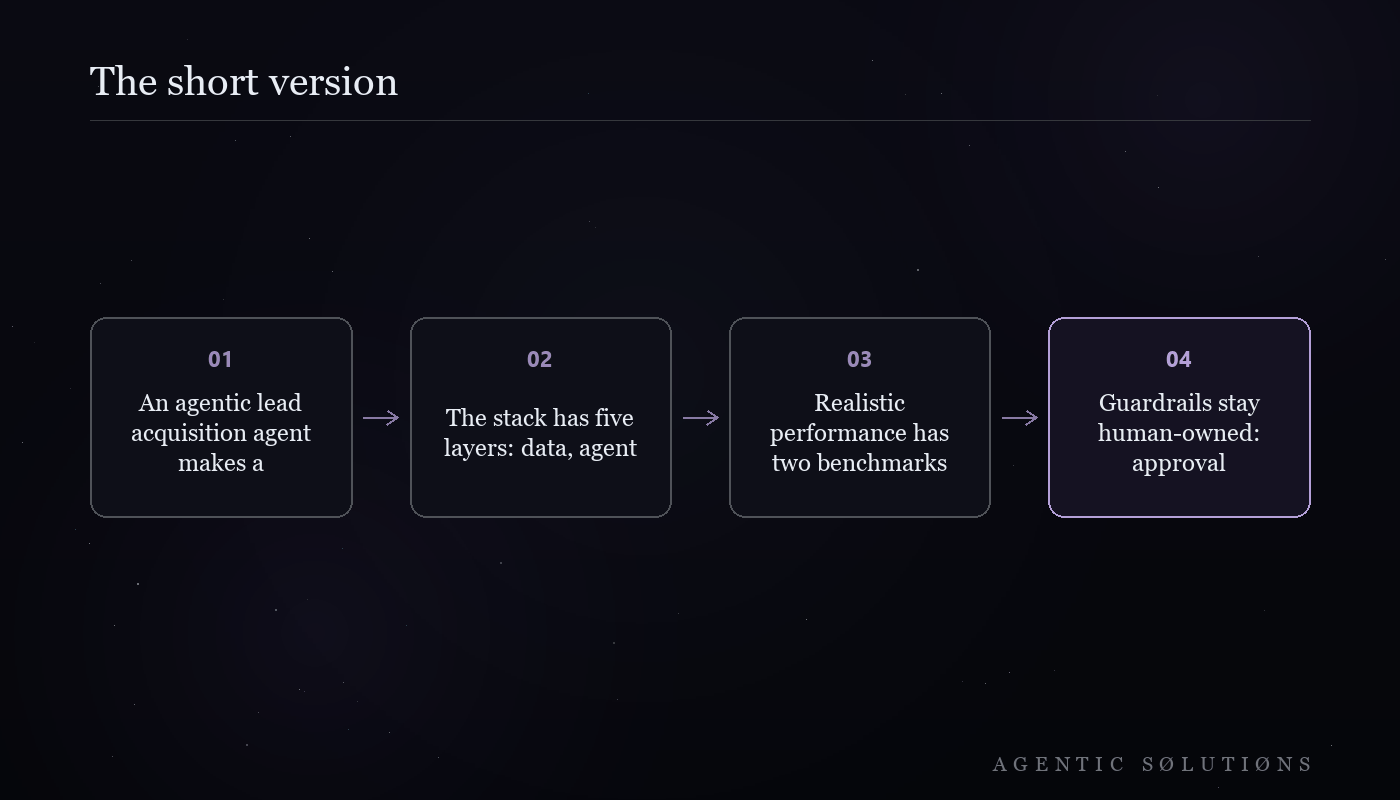
- ✓An agentic lead acquisition agent makes a judgment call at each stage of the outbound loop, while a sequencer executes the same schedule for every prospect.
- ✓The stack has five layers: data, agent and orchestration, delivery, human review gates, and reporting, and a sharp agent working a stale list still loses.
- ✓Realistic performance has two benchmarks: in a single canonical run of 555 personalized cold emails, the winning pitch pulled a 1.75% reply rate, while a tuned system targets 7% at scale.
- ✓Guardrails stay human-owned: approval gates, volume caps, and exclusion rules bound what the agent may decide on its own.
- ✓Owning the system means every reply and winning pitch compounds into an asset you keep, instead of sharpening a rented machine you lose on cancellation.
An agentic lead acquisition agent, defined
An agentic lead acquisition agent is an AI system that runs the outbound prospecting loop end to end: it sources prospects, personalizes outreach, sends across channels, and triages replies, deciding its own next step inside guardrails a human sets. A fixed drip sequence executes a schedule no matter what happens. An agent makes a judgment call at each stage, and that decision-making separates it from ordinary sales automation.
Ordinary sales automation is a script. You load a list, write the emails, set the delays, and every prospect gets the same treatment on the same clock. An agent works from the same inputs but treats each prospect as its own case, reading the data and choosing the message, channel, and timing that fit. In practice, the agent makes calls a sequencer never could.
Agentic does not mean unsupervised. We build these systems with human-set guardrails: approval gates before sending, hard caps on volume, and rules about who is off limits. The agent owns the repetitive judgment inside those boundaries, and a person owns the boundaries themselves.
We build these systems for clients, and we run our own multi-channel outbound engine across email and LinkedIn every day. That daily operation is where this definition comes from. The rest of this post unpacks the loop, the stack it sits in, and what realistic performance looks like.
- •Which prospects on a list actually fit your buyer profile
- •What each message says, grounded in that prospect's own data
- •Which channel carries the next touch, email or LinkedIn
- •When a reply needs a human and when it needs a follow-up
- •When to stop pursuing a prospect entirely
The outbound loop the agent runs end to end
The agent's work is one repeating cycle, and it owns every stage from raw list to booked meeting. Each pass through the loop produces data the next pass learns from, which is why the same system gets sharper the longer it runs.
The loop starts with data. The agent pulls prospects from raw sources, enriches each record with company and role detail, and scores it against the ideal customer profile a human defined. Records that fit move forward. Records that do not get dropped before anyone writes a word, because list quality decides more of the outcome than copy does.
Personalization is where machine volume earns its keep. A person can only research and write so many tailored messages in a day; a tuned system produces 2,500 personalized touches per day, each grounded in the prospect's own data rather than a first-name merge token. The agent then coordinates delivery across email and LinkedIn, spacing touches so the channels reinforce each other instead of colliding.
None of that matters if messages never land. The agent manages deliverability continuously: warming inboxes, throttling volume, and watching bounce and spam signals, because 98.5% deliverability is what disciplined infrastructure produces and every point below it is outreach nobody sees. When replies arrive, the agent classifies each one and routes positive responses toward a booked meeting while flagging anything ambiguous for a person.
The human gates sit at the edges. You define the ideal customer profile, approve the messaging before a campaign goes live, and take over the conversation once a real buyer engages. The agent fills the calendar; it never runs the meeting.
- •Source and enrich the prospect list
- •Qualify every record against the ideal customer profile
- •Personalize each message from prospect-level data
- •Coordinate sends across email and LinkedIn
- •Protect deliverability with warm-up, throttling, and monitoring
- •Classify replies and route positives toward a meeting
Inside the agentic go-to-market stack, layer by layer
An agentic go-to-market stack has five layers: data, agent and orchestration, delivery, human review gates, and reporting. The agent sits in the middle of that stack, and the layers around it decide whether its judgment calls turn into booked meetings. Map all five and you can diagram your own stack or audit a vendor's in an afternoon.
The data layer feeds everything above it. It holds your prospect sources, the enrichment that turns a bare name into a full record, and the profile data the agent qualifies against. When we debug an underperforming stack, we look here first, because a sharp agent working a stale list still loses.
The agent and orchestration layer is the brain of the stack. Decision logic picks the next action for each prospect, personalization models write from record-level data, and orchestration sequences the work so no prospect gets conflicting touches. Below it sits the delivery layer: the sending domains, warmed inboxes, and LinkedIn accounts that physically carry each message. Delivery is unglamorous plumbing, and it is where most stacks quietly fail.
The top layers keep humans in control. Review gates hold messages for approval wherever you place them, and the dashboard exposes every send, reply, and booked meeting so performance is inspectable rather than asserted. When we hand a client the AI BDR they own, the reporting dashboard ships with it, because a stack you cannot inspect is a stack you take on faith.
| Layer | What it holds |
|---|---|
| Data | Prospect sources, enrichment, ideal customer profile scoring |
| Agent and orchestration | Decision logic, personalization models, channel sequencing |
| Delivery | Sending domains, warmed inboxes, LinkedIn accounts |
| Human review gates | Approval before send, volume limits, exclusion rules |
| Reporting dashboard | Every send, reply, and booked meeting in one view |
Agentic versus automated: where sequences end and agents begin
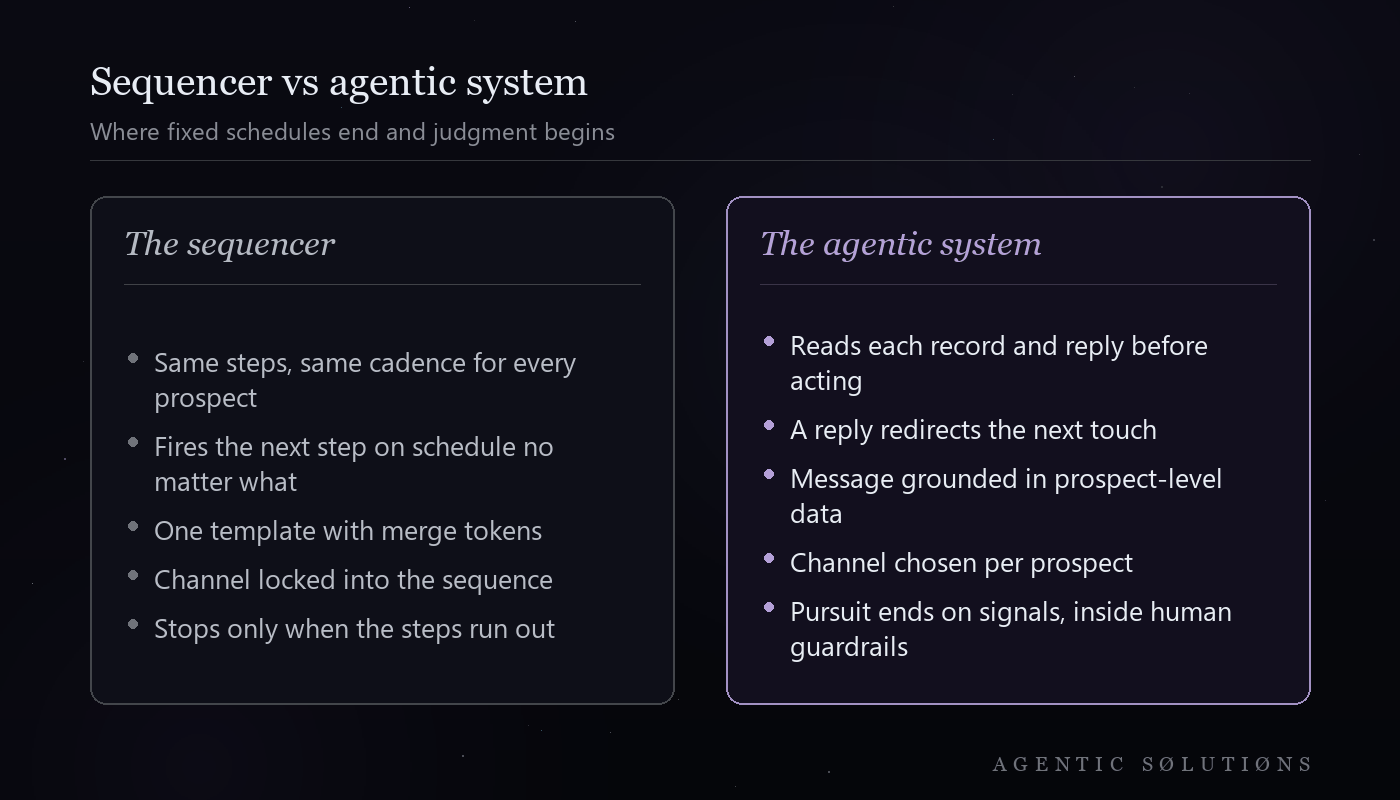
The line between automated and agentic is decision-making. A sequencer executes a fixed schedule: same steps, same cadence, same message for every prospect on the list. An agent reads each prospect's record and each reply, then chooses what happens next.
Most tools sold as AI outbound are sequencers with a text generator bolted on. They still fire the next step on schedule for everyone, whether or not the prospect opened, replied, or changed jobs since the list was pulled. The AI writes the words, but a static rule decides everything that matters.
When we evaluate a tool for a client, we apply one test: whether it decides, or only executes a schedule. Watch what the system does when something unplanned happens, because that is where the difference shows. A sequencer keeps marching through its steps no matter what. An agentic system behaves differently on every check below.
The honest caveat is that autonomy raises the stakes. A script can only fail on schedule; an agent that picks its own next step needs hard limits on what it may pick. That is why the review gates, volume caps, and exclusion rules sit where they do in the stack, and why nothing new reaches a real inbox without human sign-off. Guardrails plus human approval are what make agentic sending safe.
- •A reply arriving mid-sequence redirects the next touch instead of being queued behind it
- •Two prospects with different data get different messages, never one template
- •Channel choice is made per prospect, not locked into the sequence
- •A bad-fit record gets dropped, not mailed because it was on the list
- •Pursuit ends on signals, not because the steps ran out
What realistic performance looks like in practice
Realistic performance has two benchmarks, and honest vendors show you both. From our own daily-run engine, a canonical run of 555 personalized cold emails saw the winning pitch pull a 1.75% reply rate. A fully tuned system targets a 7% reply rate at scale with 80% positive sentiment and 10-15 qualified meetings per month.
Those numbers are not a contradiction. The 1.75% is a measured result: what the winning pitch actually pulled in a single canonical run of 555 personalized cold emails. The 7% is what the same loop targets at scale after sustained iteration, once losing pitches are dead and the list criteria have been tightened by real reply data.
The gap closes through work, not waiting. Every pass through the loop shows us which pitch earns replies and which list segments respond, and the next run inherits those learnings. Pitch iteration and list quality do most of the lifting; volume alone never rescues a weak message.
The gap is also your vendor screen. Anyone quoting only peak numbers is hiding the climb, because every system starts below its ceiling and earns its way up. Ask for measured run numbers alongside the targets and how long the tuning took; the answer tells you whether they have run this loop or only read about it.
Vendor test
Ask for measured run numbers alongside peak numbers. A vendor who cannot show you both has either never run the loop or does not want you to see the results.
Owning the agent versus renting the output
The last buying decision is ownership. A lead vendor rents you output: meetings show up while you pay, and nothing remains when you stop. Owning the AI BDR means the system itself, and everything it learns, belongs to you.
The rented model has a cost that compounds quietly. Every reply, every winning pitch, and every responsive list segment sharpens a machine you cannot see inside and cannot take with you. Cancel the subscription and you start over at zero, holding the same cold lists you had on day one.
Ownership inverts that math. The loop this post described improves with every pass, and when the stack is yours, those improvements accrue to your pipeline instead of a vendor's next client. You can audit every layer because you hold every layer, and everything below belongs to you.
Owning the system does not mean waiting through a long build. A scoped implementation puts the first automation live in 7 days, and the engine compounds from there, run by run. If you want to see what the stack looks like against your own list and offer, book a scoping call and we will map it with you.
- •The prospect lists and every enrichment on them
- •The sending domains and warmed inboxes
- •The reply data and the pitches it proved
- •The reporting dashboard and its full history
Who This Is For (And Who It Is Not)
A fit for
- ✓Growing service businesses that need outbound pipeline without hiring an SDR team
- ✓Founders evaluating AI outbound vendors who need a test to separate real agents from sequencers
- ✓Operators who want to own their outbound system and its data rather than rent meetings
- ✓Teams running fixed drip sequences who have hit the ceiling of same-message-same-clock outreach
Not a fit for
- ×Businesses expecting peak reply rates from a first campaign
- ×Anyone wanting a fully hands-off system with no human approval gates or oversight
- ×Teams unwilling to define an ideal customer profile or review messaging before launch
Limitations
- •Measured results sit below the tuned target; in our single canonical run of 555 personalized cold emails, the winning pitch pulled a 1.75% reply rate against a 7% at-scale goal, and closing that gap takes sustained iteration.
- •The agent's judgment is capped by the data layer feeding it; a stale or poorly enriched list loses no matter how sharp the decision logic is.
- •Autonomy raises the stakes, so the system depends on human-set guardrails, and a person must define and maintain the approval gates, volume caps, and exclusion rules.
- •Humans stay in the loop by design: someone must define the ideal customer profile, approve messaging before campaigns go live, and take over every conversation once a buyer engages.
FAQ
How is an agentic lead acquisition agent different from hiring an SDR?
An agent handles the repetitive judgment in outbound at machine volume: a person can only research and write so many tailored messages in a day, while a tuned system produces 2,500 personalized touches per day. The human role shifts to owning the boundaries, meaning you define the ideal customer profile, approve the messaging, and take over once a real buyer engages. The agent fills the calendar; it never runs the meeting.
What reply rate should I realistically expect from AI-run cold outbound?
Expect two benchmarks rather than one. In our own single canonical run of 555 personalized cold emails, the winning pitch pulled a 1.75% reply rate. A fully tuned system targets a 7% reply rate at scale with 80% positive sentiment, and the gap closes through pitch iteration and list tightening, not waiting.
Do I own the agentic outbound system, or am I renting it from the vendor?
It depends on which model you buy. A lead vendor rents you output: meetings arrive while you pay, and canceling leaves you at zero with the same cold lists you started with. In the ownership model, the AI BDR plus the prospect lists, sending domains, warmed inboxes, reply data, and reporting dashboard all transfer to you, so every improvement accrues to your pipeline instead of a vendor's next client.
How long does it take to get an agentic lead acquisition system live?
A scoped implementation puts the first automation live in 7 days. From there the engine compounds run by run: each pass through the loop feeds reply data back into pitch selection and list criteria, so the system sharpens with use rather than launching at its ceiling.
About Agentic Solutions
Agentic Solutions is a US-based AI consulting and implementation firm that builds done-for-you AI systems: an AI BDR you own for outbound lead generation, plus custom operations automation, for staffing and recruiting agencies, non-AI SaaS companies, med spas and wellness clinics, accounting firms, and insurance agencies. Engagements are high-ticket implementations with the first automation live in 7 days. It is not a marketing agency.
Jabulani Aduwo
Founder, Agentic Solutions
Update History
- Published
30 minutes. No pitch deck. No pressure.