What does an AI BDR cost for staffing and recruiting agencies?
The Short Answer
There is no published price for an AI BDR, and the number that decides whether one works for a staffing or recruiting agency is your fully loaded cost per qualified meeting. Four lines drive it: data sourcing, sending infrastructure, the AI writing layer, and human oversight. A properly built program is sized for 10-15 qualified meetings per month. Our engagements are high-ticket implementations, so we scope pricing against your placement fee and desk volume on a call.
Key Takeaways
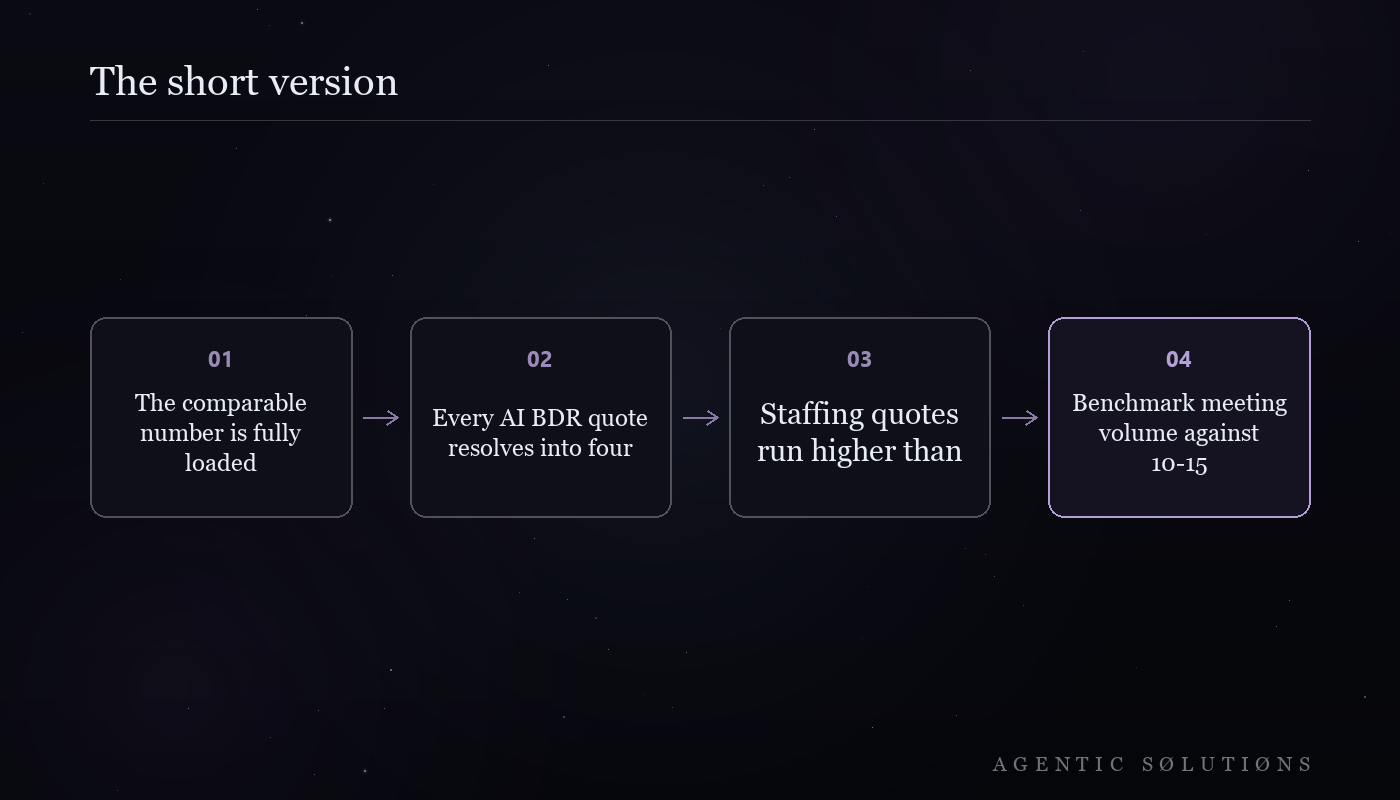
- ✓The comparable number is fully loaded cost per qualified meeting, not the software fee a vendor quotes you.
- ✓Every AI BDR quote resolves into four lines: data, sending infrastructure, the AI layer, and human oversight and reply handling.
- ✓Staffing quotes run higher than one-directional B2B builds because prospecting hiring managers and sourcing candidates are two data sets, two message frameworks, and two sets of sending infrastructure.
- ✓Benchmark meeting volume against 10-15 qualified meetings per month, then divide annual program cost by placement fee times close rate times placements per client to get payback.
- ✓Cheap quotes are usually cheap because a cost line was deleted, and the failure shows up in month three after domain reputation is spent.
The Short Answer: You Are Buying a Cost Per Qualified Meeting, Not Software
There is no single sticker price for an AI BDR, and any vendor who gives you one before asking about your placement volume is selling a subscription. The number that decides whether this works for a staffing agency is fully loaded cost per qualified meeting. Everything else is line items on the way to that figure.
Three things move the range more than anything else. First, whether you are buying a build you own or renting a seat in someone else's platform. Second, how much of the stack transfers to you at the end, including the sending infrastructure and the reporting dashboard. Third, whether custom operations automation is in scope alongside outbound, because that work is priced separately from the AI BDR itself.
We publish ranges only when we can point at a source for them. We do not publish ours, because a staffing agency running two recruiters and one desk and an agency running twelve desks across four verticals are not the same build. Scoping happens on a call, against your actual numbers.
Use the mental model below on every vendor you talk to, including us. It turns a quote into something you can compare against the recruiter hours you are already spending on outbound.
Ask each vendor to state their number as a monthly total, then divide it by the qualified meetings they commit to. A vendor who will not commit to a meeting volume is asking you to pay for activity.
- •Total monthly cost, all lines included, not just the software fee
- •Qualified meetings the program is sized to produce
- •What you own on day one and what you own if you leave
- •Whether operations automation is in scope or a separate build
- •How fast the first automation goes live
The Four Cost Lines Behind Any AI BDR Quote
Every AI BDR quote resolves into four cost lines, whether or not the vendor breaks them out for you. Two of them are one-time build work and two of them recur every month you run the program. A quote that collapses all four into a single seat fee is hiding which part you actually own.
Data is the first line. For a staffing agency that means sourcing hiring managers at companies with placeable roles open, not a generic firmographic pull, and it means refreshing that list as reqs open and close. This is ongoing spend, and it is the line most often quietly downgraded to a shared database that your competitors are also emailing.
Sending infrastructure is the second. Secondary domains, inboxes, warmup, and the monitoring work that sits behind a number like 98.5% deliverability are a build cost first and a smaller monthly cost after. We treat this as its own line because it is the one that quietly decides whether anything else works.
The AI layer is the third, and it is where volume changes the shape of the bill. Writing and personalizing at a rate of 2,500 personalized touches per day is a build cost in the prompt and research pipeline, then a usage cost that scales with send volume. Human oversight and reply handling is the fourth, and it never goes to zero. Somebody reviews the copy, works the replies, and decides what a positive response means before it reaches a recruiter's calendar.
| Cost line | Build or ongoing | What it buys |
|---|---|---|
| Data and list sourcing | Ongoing | Hiring managers at companies with open reqs |
| Sending infrastructure | Build, then ongoing | Domains, inboxes, warmup, deliverability monitoring |
| AI writing and personalization | Build, then usage | Personalized touches at daily volume |
| Oversight and reply handling | Ongoing | Copy review, reply triage, meeting qualification |
Why Staffing Agencies Price This Differently Than Other Industries
Staffing economics change what an AI BDR is worth, not just what it costs. A single won client account carries placement fees for years, so the program clears its own cost at a volume most industries would consider a rounding error. That is why the same build gets priced against a different denominator here.
Outreach in staffing runs two directions. You are prospecting hiring managers for open reqs and, on many desks, sourcing candidates to fill them. Those are two separate data sets, two message frameworks, and two sets of sending infrastructure if you run them properly, which is the single biggest reason a staffing quote comes in above a one-directional B2B build.
Req cycles also stretch the payback window. Hiring freezes, budget resets, and seasonal peaks mean a manager who ignores you in March signs in September, so the program has to be funded across a cycle rather than judged on a short trial. Agencies that kill outbound a few weeks in pay full build cost and collect none of the compounding.
The real comparison is not another vendor. It is the hours your recruiters currently spend building lists, writing sequences, and chasing non-responses instead of working live reqs. Representative outcomes from prior work include 140 hours/month saved in logistics, and that hours line is the number most agencies underprice when they evaluate a quote.
Return context
One representative staffing engagement produced +61% revenue in 6 months. When a program moves the revenue line that far, the conversation stops being about monthly cost and starts being about how fast you can get it running.
The Math That Actually Decides It: Cost Per Meeting and Payback
Take the total monthly program cost, every line included, and divide it by the qualified meetings it actually produces. That single number is comparable across every vendor you talk to. Then work backward from your own placement fee to find out how many months the program takes to pay for itself.
Benchmark the meeting side against 10-15 qualified meetings per month, which is the volume a properly built program is sized to produce for an agency. If a vendor quotes a monthly fee but will not name a meeting range, you have no denominator and no way to price the deal. If they name one far above that band, ask what they are counting as qualified.
Payback comes from your side of the ledger, not ours. Take your average placement fee, multiply by the share of meetings that become clients, and multiply again by the placements each client sends you in a year. Divide the annual program cost by that figure and you have the number of months before it is free.
Reply quality is what moves the meeting count, so ask for the rate and for the share of it worth working. We point at a 7% reply rate at scale with 80% positive as the benchmark we build toward. In our own canonical run of 555 personalized cold emails, the winning pitch pulled a 1.75% reply rate, and reply rates move that much between pitches inside a single run.
Run the calculation at the conservative end. If the cost per meeting still clears your placement economics when reply rates come in low, the program is safe to fund.
Outcome benchmark
Across engagements we point at 4.2x average ROI as the benchmark we build toward. It is a benchmark drawn from prior work, not a guarantee attached to your quote.
Cheap Quotes That Get Expensive: What to Check Before You Sign
A cheap AI BDR quote is usually cheap because a cost line was deleted, not because the vendor is efficient. The lines that get cut are the ones whose failure shows up in month three, after your domain reputation is already spent. Check for them before you sign, because most are not reversible.
Ask where the data comes from and how often it refreshes. A shared or recycled list means the hiring managers you are contacting have already been worked by three other agencies this quarter, and no amount of copy quality recovers a burned inbox. Ask whether the list is yours or the vendor's, and what happens to it when the engagement ends.
Ask which domain the mail leaves from. Any vendor willing to send volume from your primary domain is putting your recruiters' day-to-day email at risk to save a setup fee, and there is no monitoring in that arrangement to catch it early. The same applies to AI copy that no human reviews before it goes out at daily volume.
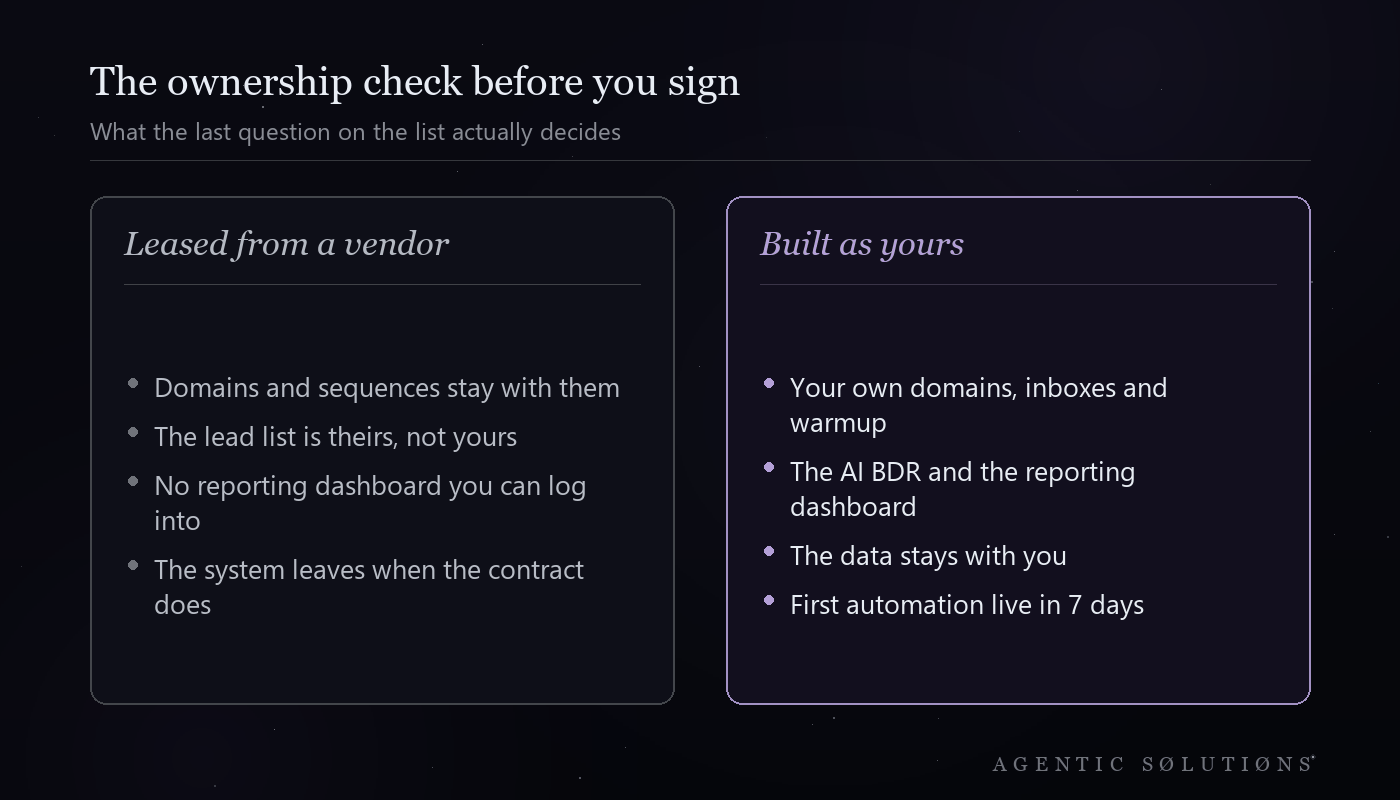
The last check is ownership. Some vendors lease you the system, which means the domains, the sequences, the data, and the reporting stay with them the day you stop paying. We build the AI BDR and the reporting dashboard as yours, and we hold to first automation live in 7 days, because a real implementation produces something running inside a week rather than a deck.
- •Shared or recycled lead lists you do not own
- •Sending from your primary domain
- •No deliverability monitoring after launch
- •AI copy that no human reviews
- •No reporting dashboard you can log into
- •A system that leaves when the contract does
How to Scope Your Own Number in One Conversation
A specific number takes one conversation, not a discovery phase. Bring four inputs and we can size the build, the meeting volume, and the timeline against your desk economics on the call. We are an implementation firm, so pricing is scoped to what gets built rather than published on a page.
Start with your average placement fee and your current meeting volume. Those two numbers set the denominator on everything above, and without them any quote you receive is a guess wearing a proposal cover.
Then count the hours. How much recruiter time goes into list building, sequence writing, and chasing non-responses each week is the baseline the program replaces, and it is usually the largest number in the conversation. Bring the ops workflows that bleed time too, because custom operations automation is scoped alongside the AI BDR and changes the shape of the build.
We do not sell campaigns or manage a channel for you. We build the system, hand you the AI BDR and the reporting dashboard, and hold to first automation live in 7 days. If you want your own number, book a call and bring the four inputs below.
- •Average placement fee per client
- •Qualified meetings you book per month today
- •Recruiter hours per week spent on outbound
- •Ops workflows costing the most manual time
Who This Is For (And Who It Is Not)
A fit for
- ✓Staffing and recruiting agencies comparing AI BDR quotes from multiple vendors
- ✓Agency owners whose recruiters spend hours each week on list building and sequence writing
- ✓Agencies with a known average placement fee and current meeting volume to price against
- ✓Owners who want to own the outbound system and the reporting dashboard outright
Not a fit for
- ×Agencies looking for a published price without a scoping conversation
- ×Teams that will judge outbound on a short trial and cut it before a req cycle turns
- ×Anyone wanting a campaign or a managed channel rather than a system they own
Limitations
- •The 10-15 qualified meetings per month band is what a properly built program is sized to produce, not a guaranteed floor for any given desk.
- •The 1.75% reply rate is what the winning pitch pulled in our own 555-email canonical run, not an aggregate rate for that run and not a projection for any other program.
- •Payback math depends on inputs only you have, including average placement fee, meeting-to-client conversion, and placements per client per year.
- •The 4.2x average ROI and +61% revenue in 6 months figures are benchmarks drawn from prior engagements, not commitments attached to a quote.
FAQ
Is an AI BDR a monthly subscription or a one-time build cost?
Most quotes contain both, and one that hides the split is hiding what you own. Sending infrastructure and the AI writing pipeline are built once, then monitored and run. Data sourcing and human oversight are ongoing work every month the program runs. Ask the vendor to break out which lines are build and which recur.
How many qualified meetings should a staffing agency expect early on?
A properly built program is sized to produce 10-15 qualified meetings per month, and that is the band to benchmark any vendor against. Reply rates move with the pitch: in our own canonical run of 555 personalized cold emails, the winning pitch pulled a 1.75% reply rate, and we point at a 7% reply rate at scale with 80% positive as the benchmark we build toward. Req cycles stretch the window further, since a hiring manager who ignores you in March can sign in September. Fund the program across a cycle rather than judging it on a short trial.
Do I still need a human SDR or recruiter once the AI BDR is running?
Yes. Human oversight and reply handling is one of the four cost lines and it never goes to zero. Somebody reviews the copy before it goes out at daily volume, works the replies, and decides what counts as a positive response before a meeting reaches a recruiter's calendar. What changes is where recruiter hours go: out of list building, sequence writing, and chasing non-responses, and into live reqs.
What happens to the system and the data if we stop the engagement?
That depends entirely on who owns the build, which is why it is the last thing to check before signing. Some vendors lease you the system, so the domains, sequences, data, and reporting leave with them the day you stop paying. We build the AI BDR and the reporting dashboard as yours. Ask any vendor what you own on day one and what you own if you leave.
About Agentic Solutions
Agentic Solutions is a US-based AI consulting and implementation firm that builds done-for-you AI systems: an AI BDR you own for outbound lead generation, plus custom operations automation, for staffing and recruiting agencies, non-AI SaaS companies, med spas and wellness clinics, accounting firms, and insurance agencies. Engagements are high-ticket implementations with the first automation live in 7 days. It is not a marketing agency.
Jabulani Aduwo
Founder, Agentic Solutions
Update History
- Published
30 minutes. No pitch deck. No pressure.