AI BDR vs hiring an SDR: the real cost comparison for staffing agencies
The Short Answer
An AI BDR beats a human SDR on cost per qualified meeting for most staffing agencies, while an SDR still wins when selling is phone-heavy and relationship-driven. The SDR seat carries salary, commission, benefits, tools, management time, and a multi-month ramp that resets with every resignation. An AI BDR is a one-time implementation you own, live in 7 days, benchmarked at 10-15 qualified meetings per month. Divide total spend by meetings booked to settle it for your agency.
Key Takeaways
- ✓An AI BDR wins on cost per qualified meeting, while a human SDR still earns the seat when the selling is phone-first and relationship-driven.
- ✓The honest SDR number is the fully loaded cost of the seat, including tools, management hours, ramp, and empty months, divided by meetings actually booked.
- ✓An AI BDR is a one-time implementation you own, live in 7 days, benchmarking at 10-15 qualified meetings per month.
- ✓Honest cold outbound at real volume looks like a 1.75% reply rate on a 555-email run, and it still fills calendars when the list and the pitch are right.
- ✓Most agencies land on a hybrid where the AI BDR fills the top of the funnel and recruiters run the phone-heavy conversations that become placements.
The short answer: an AI BDR wins on cost per meeting, an SDR wins on the phone
For most staffing agencies, an AI BDR wins on cost per qualified meeting and is live in 7 days instead of months of ramp. A human SDR still earns their seat when the selling is phone-heavy and relationship-driven. The rest of this post breaks down the full cost structure of each option so you can run the math on your own agency.
We build AI BDR systems and run our own multi-channel outbound engine every day, so this verdict comes from operating both sides. Cold outbound at volume is work that software now does better and cheaper. Live conversations with candidates and hiring managers are still work a person does better.
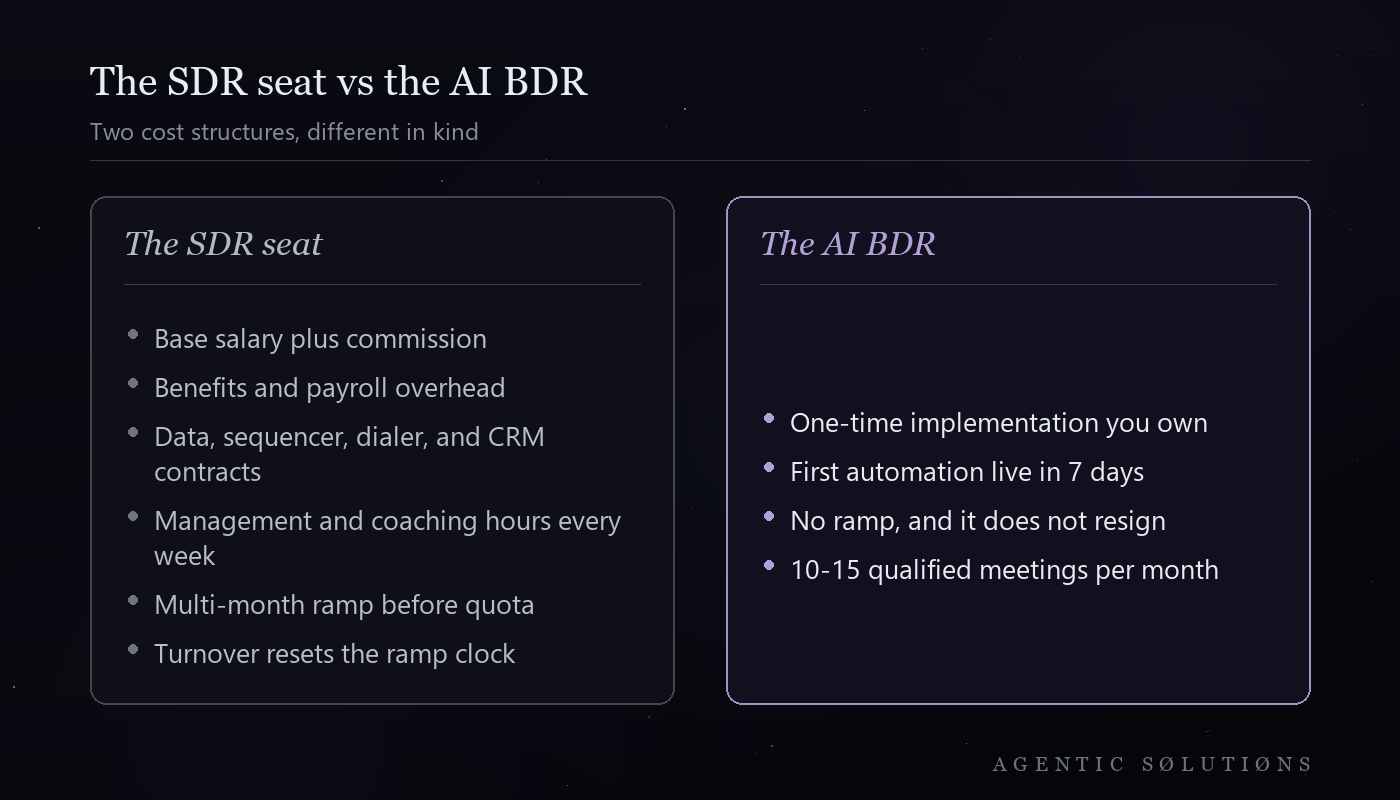
The two cost structures are different in kind, which is why salary-line comparisons mislead. An SDR is a recurring salary plus benefits, tools, management time, and a ramp period before quota. An AI BDR is a one-time implementation you own outright, with the first automation live in 7 days.
The sections below itemize every cost category on both sides, then reduce them to the one number that matters: cost per qualified meeting. Fill in your own figures as you read and you will have a defensible answer by the end.
| Factor | AI BDR | Human SDR |
|---|---|---|
| Time to launch | First automation live in 7 days | Months of hiring and ramp |
| Cost shape | One-time implementation you own | Recurring salary plus overhead |
| Best at | High-volume outbound across email and LinkedIn | Phone-first, relationship-driven selling |
| Turnover risk | It does not resign | Resets the ramp clock |
What an SDR really costs a staffing agency beyond base salary
The salary line is the smallest honest number on an SDR hire. Commission, benefits, tools, management time, and ramp stack on top of it before the first meeting gets booked. The real cost of the seat is the fully loaded total divided by meetings actually booked.
Start with direct compensation: base plus commission, then benefits, payroll taxes, and employer overhead on top. We will not quote salary figures here because they swing by market and seniority. Pull your own numbers from your last offer letter and your payroll report, and write down the fully loaded annual figure.
The seat also needs a tool stack before a single email goes out. That means a contact data provider, an email sequencer, a dialer, and CRM seats, each on its own contract. Those contracts renew whether the rep books meetings or not.
Then come the costs that never show up on an invoice. Someone senior has to write sequences, coach calls, and review pipeline every week, and a new rep needs a multi-month ramp before hitting quota. When that rep resigns, the ramp clock resets and you pay recruiting and training costs again while the seat produces nothing.
Now do the honest division. Take the fully loaded total, including tools, management hours, and the empty months between hires, and divide it by the meetings the seat actually booked over the year. That quotient is the number we will compare against an AI BDR in the next two sections.
- •Base salary plus commission and bonuses
- •Benefits, payroll taxes, and employer overhead
- •Data, sequencer, dialer, and CRM contracts
- •Management and coaching hours every week
- •Multi-month ramp before full quota
- •Turnover and re-hiring while the seat sits empty
What an AI BDR costs and what it does all day
An AI BDR replaces the recurring salary line with a one-time high-ticket implementation you own outright, including a reporting dashboard. Every cost category from the last section either disappears or collapses into the build.
The day job is volume no human seat can touch. The system sends up to 2,500 personalized touches per day across email and LinkedIn, each one written for the specific recipient rather than blasted from a template. It holds 98.5% deliverability, and at scale it pulls a 7% reply rate with 80% positive, which means the replies coming back are mostly conversations worth having.
It also never behaves like an employee. It does not take breaks, does not ramp, and does not resign and reset your pipeline while you rehire. Sick days, holidays, and quiet Decembers do not slow it down either. The first automation is live in 7 days, so the gap between signing and sending is measured in days rather than quarters.
The tool stack question disappears as well, because the system is the stack. Sending infrastructure and the reporting dashboard ship with the build, and the dashboard shows exactly what went out and what came back. Management shrinks to reading it and deciding which replies your recruiters take.
We do not publish pricing here because every build depends on your stack, your niche, and your target market. The build is high-ticket, and we would rather scope it honestly than quote a number that ignores your market. If you want a real number for your agency, book a scoping call and we will scope the implementation directly.
- •No base salary or commission
- •No benefits or payroll overhead
- •No separate data, sequencer, or dialer contracts
- •No multi-month ramp before production
- •No empty seat between hires
Cost per qualified meeting: the only number that settles this
This comparison settles on one quotient: everything you spend on a channel divided by the qualified meetings it books. An AI BDR benchmarks at 10-15 qualified meetings per month, and the spend behind it is a build you already own. Run the same division on an SDR seat and ramp, turnover, and empty months shrink the denominator fast.
The SDR denominator erodes in ways the payroll report never shows. A new rep spends months at partial output, a resignation zeroes production while the loaded costs keep accruing, and the seat books nothing between hires. Divide the fully loaded figure from section two by the meetings that actually reached a calendar across the whole year, and the quotient climbs uncomfortably.
The AI BDR denominator holds steady because the system sends every day without ramp or resignations. We can say that plainly because we run our own multi-channel engine daily and track every send it makes. One canonical run pushed 555 personalized cold emails into the market, and the winning pitch pulled a 1.75% reply rate.
We quote 1.75% deliberately. That is what honest cold outbound looks like at real volume, and it still fills calendars when the list and the pitch are right. A vendor who only shows you their best morning is selling a screenshot, so judge every option, including ours, on cost per qualified meeting booked.
Staffing outcome
A representative staffing client grew revenue +61% in 6 months with the AI BDR filling the top of the funnel. The meetings are the mechanism, and that growth is what the division buys.
When hiring an SDR is still the right call
We build AI BDR systems for a living, and we will still tell some agencies to hire a human. Phone-first niches, complex enterprise deals, and existing-account growth all favor a person with a voice and a memory. Arguing otherwise would be selling, not advising.
The clearest case is a phone-first niche. If your candidates and hiring managers expect a live voice before they trust you with a req, a human who can hold that call earns the seat. No sequence replaces a rep who picks up the phone and gets picked up in return.
Complex enterprise staffing deals are the second case. When a deal runs through procurement, legal, and several hiring managers over multiple quarters, someone has to track every thread and work the relationships between meetings. Outbound software opens that door. A person walks through it and keeps it open.
The third case is farming the accounts you already have. Expansion revenue comes from check-in calls, quick favors, and relationships built over years, and that is human work an outbound system should never touch. Point the machine at strangers and point your people at the clients who already pay you.
The hybrid model
Most agencies land on both: the AI BDR fills the top of the funnel with qualified meetings, and your recruiters and closers run the phone-heavy conversations that turn them into placements.
How to run the numbers for your agency this week
You can settle this decision with one spreadsheet session this week. Compute your loaded SDR cost per qualified meeting, compare it against 10-15 qualified meetings per month from an owned system, and let your niche's phone-dependence break any tie.
Start with the SDR side. Pull the cost categories from section two, add them into one loaded annual figure, and divide by the meetings the seat actually booked. Be honest about ramp months and empty-seat gaps, because the costs kept accruing while the meetings did not.
Then fill in the other column. An owned system benchmarks at 10-15 qualified meetings per month, and the first automation is live in 7 days, so the ramp row on that side reads days instead of months. If your niche matches the phone-first cases from the last section, weight the human seat accordingly before you decide.
Implementation specifics depend on your stack, your niche, and your target market, so we scope every build individually. If the math points toward an owned system, book a scoping call and we will run these numbers against your own pipeline with you.
- •Total your loaded SDR cost, including tools, management hours, and empty months
- •Divide by meetings actually booked over the year
- •Compare against 10-15 qualified meetings per month
- •Weigh months of ramp against first automation live in 7 days
- •Score how phone-dependent your niche really is
Who This Is For (And Who It Is Not)
A fit for
- ✓Staffing and recruiting agency owners weighing an SDR hire against an outbound system
- ✓Agencies whose outbound runs on high-volume email and LinkedIn rather than the phone
- ✓Founders who want a defensible cost per qualified meeting before committing budget
- ✓Agencies burned by SDR turnover and repeated ramp resets
Not a fit for
- ×Phone-first niches where hiring managers expect a live voice before trusting you with a req
- ×Agencies whose growth comes mainly from farming existing accounts
- ×Teams whose pipeline runs through multi-quarter enterprise deals that need a dedicated relationship owner
Limitations
- •An AI BDR cannot hold a live phone call, so phone-first niches and complex enterprise deals still need a human rep.
- •Honest cold outbound reply rates stay low even when the system works; our canonical 555-email run pulled a 1.75% reply rate on the winning pitch.
- •The build is a high-ticket upfront implementation whose specifics depend on your stack, niche, and target market, so getting a real number requires a scoping call.
- •The system should only be pointed at strangers; expansion revenue from accounts you already have stays human work.
FAQ
How many qualified meetings per month can an AI BDR realistically book for a staffing agency?
The benchmark is 10-15 qualified meetings per month. That output comes from a system sending up to 2,500 personalized touches per day across email and LinkedIn at 98.5% deliverability. Judge any vendor, including us, on cost per qualified meeting rather than raw activity.
How long does it take to get an AI BDR live compared to ramping a new SDR?
The first automation is live in 7 days, so the gap between signing and sending is measured in days rather than quarters. A new SDR needs months of hiring and ramp before hitting quota, and a resignation resets that clock while the seat produces nothing.
Will AI-written cold emails actually land in the inbox and get replies?
The system holds 98.5% deliverability, and at scale it pulls a 7% reply rate with 80% positive. From our own engine, one canonical run of 555 personalized cold emails pulled a 1.75% reply rate on the winning pitch. We quote that number deliberately because that is what honest cold outbound looks like at real volume, and it still fills calendars when the list and the pitch are right.
Does an AI BDR replace my recruiters and salespeople, or work alongside them?
It works alongside them. The AI BDR fills the top of the funnel with qualified meetings, and your recruiters and closers run the phone-heavy conversations that turn them into placements. Point the machine at strangers and point your people at the clients who already pay you.
About Agentic Solutions
Agentic Solutions is a US-based AI consulting and implementation firm that builds done-for-you AI systems: an AI BDR you own for outbound lead generation, plus custom operations automation, for staffing and recruiting agencies, non-AI SaaS companies, med spas and wellness clinics, accounting firms, and insurance agencies. Engagements are high-ticket implementations with the first automation live in 7 days. It is not a marketing agency.
Jabulani Aduwo
Founder, Agentic Solutions
Update History
- Published
- Added visual system
30 minutes. No pitch deck. No pressure.