What does an AI consultant actually do? (And when you do not need one)
The Short Answer
An AI consultant identifies where AI can remove manual work or generate revenue in a specific business, then designs, builds, and maintains the systems that do it. Advice-only consultants stop at an audit and a roadmap your team executes. Implementation firms such as Agentic Solutions build and deploy the systems themselves, with the first automation live in 7 days. Skip both when your processes still change weekly, your volume is low, or an off-the-shelf tool already solves the problem.
Key Takeaways
- ✓If the engagement ends with a recommendations deck you hired an advisor; if it ends with a system your team runs and owns, you hired an implementer.
- ✓Every competent AI engagement runs the same arc: audit the process, build one system, deploy it into daily operations, and measure it against hard numbers.
- ✓A first automation live in 7 days beats a perfect system that ships next quarter, because real data in week one keeps the build honest.
- ✓Businesses with real operational volume and no technical team fit done-for-you implementation; teams with engineers to execute usually only need advisory.
- ✓Undocumented processes, single-tool problems, low volume, or spare engineering capacity are all signals to wait rather than hire.
The short answer: an AI consultant turns AI from an idea into working systems
An AI consultant identifies where AI can remove manual work or generate revenue in a specific business, then designs, builds, and maintains the systems that do it. That is the whole job: turning a general-purpose technology into working systems tied to your processes, your data, and a measurable result.
The word consultant hides a split that matters more than anything else in this market. Advice-only consultants study your operation and hand your team a roadmap to execute. Implementation firms do the same analysis, then build, deploy, and maintain the systems themselves, so the engagement ends with software running in your business.
We sit on the implementation side of that line. Agentic Solutions builds done-for-you AI systems for staffing and recruiting agencies, non-AI SaaS companies, med spas and wellness clinics, accounting firms, and insurance agencies. The two builds we ship most often are an AI BDR you own for outbound lead generation, and custom operations automation for the back office.
Both models have a place, and this post also covers the cases where you should hire no one at all. But settle which one you are buying before you compare anyone on expertise or cost. Everything else in the engagement flows from that answer.
The dividing line
If the engagement ends with a recommendations deck, you hired an advisor. If it ends with a system your team runs and owns, you hired an implementer.
The actual work: audit, build, deploy, measure
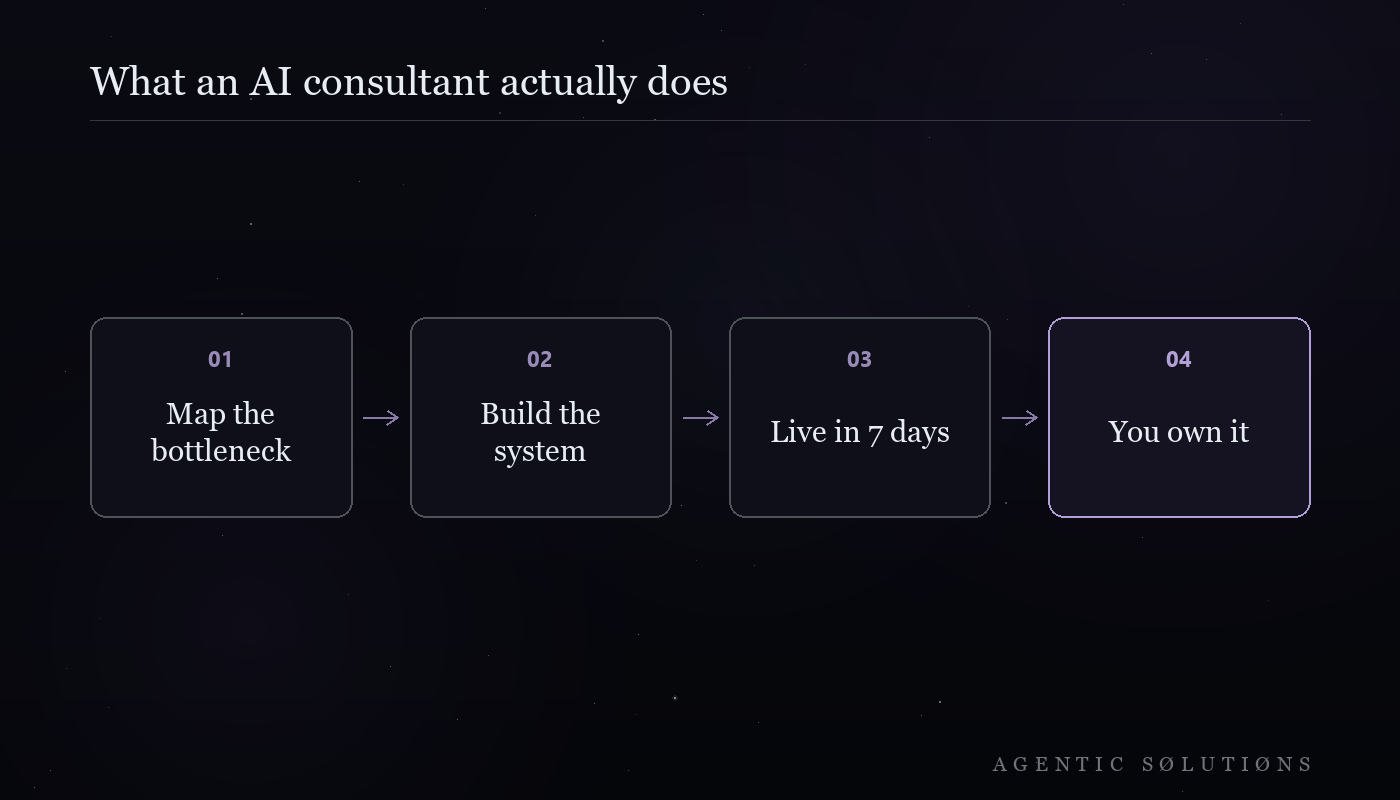
Every competent AI engagement runs the same four-stage arc: audit the process, build one system, deploy it into daily operations, and measure it against hard numbers. The tools change by industry, but the lifecycle does not, and you can judge any consultant by how concretely they describe each stage.
The audit comes first. We map how work actually moves through the business: where leads enter, where handoffs stall, and which tasks eat staff hours without requiring judgment. The output is a short list of automatable bottlenecks ranked by expected payback, not a strategy binder. From that list we scope the single use case with the highest expected return, and in most businesses it is one of two things: outbound lead generation or back-office operations.
Build and deploy run together, and speed here is a signal worth watching. We put the first automation live in 7 days, because a system producing real data in week one beats a perfect system that ships next quarter. Live means wired into your actual tools and running on real leads or real tickets, with your team trained to operate it.
Measurement is where advice-only engagements quietly end and implementation engagements keep earning their fee. Every system we ship reports into a dashboard you can check without calling us. For an outbound build, the numbers that matter are deliverability, reply rate, positive reply share, and meetings booked. The standards we hold a mature engine to are 98.5% deliverability, a 7% reply rate at scale with 80% positive, and 10-15 qualified meetings per month.
The dashboard also keeps the engagement honest. When reply rate dips or deliverability slides, we see it the same day you do and fix the system, not the report. That feedback loop is the difference between owning an asset and renting a promise.
| Stage | What happens | What you get |
|---|---|---|
| Audit | Map workflows and bottlenecks | Ranked automation shortlist |
| Build | Assemble the scoped system | Working software in your stack |
| Deploy | Wire into live tools | First automation live in 7 days |
| Measure | Track results on a dashboard | Reply rate, deliverability, meetings booked |
Consultant, implementation firm, or in-house hire: which model fits
There are three ways to buy AI help: a strategy-only consultant who hands you recommendations, a done-for-you implementation firm that builds systems you own, and an in-house hire who builds under your roof. The right model depends on whether you have engineers on payroll, how fast you need results, and who will maintain the system in year two.
A strategy-only consultant fits a company that already employs people who can build. A SaaS company with an engineering team often needs exactly this: an outside audit, a prioritized roadmap, and a second opinion on architecture, while execution stays in-house. Without builders on staff, that roadmap will sit in a drive folder unexecuted.
A done-for-you implementation firm fits businesses with real operational volume and no technical team. A staffing agency, accounting firm, med spa, or insurance agency rarely employs anyone who can build and maintain an outbound engine, so buying the finished system is the shortest path to one. This is the model we run: we build the system, deploy it into your stack, and you own it when we are done.
Hiring in-house buys the most control and the slowest start. Recruiting, onboarding, and shipping a first working system can take months before anything touches revenue, and a single hire concentrates all the knowledge in one person. It makes sense once AI systems become core to how you compete, often after a done-for-you partner has already proven which automations pay.
| Model | You get | Best fit |
|---|---|---|
| Strategy-only consultant | Audit and roadmap, no build | Teams with engineers to execute |
| Done-for-you implementation firm | Working systems you own | Staffing, accounting, med spa, insurance teams |
| In-house hire | Full control, slowest start | AI as a core competency |
When you do not need an AI consultant
Not every business is ready to hire an AI consultant, and hiring too early wastes money on both sides. If your processes are undocumented, your problem fits one off-the-shelf tool, your volume is too low to pay back a build, or your engineers have spare capacity, the honest answer is to wait. Here is what to do in each case instead.
Automation freezes a process in software, so a process that changes weekly is not ready to freeze. If your intake steps, follow-up cadence, or handoffs shift every time someone has a new idea, write them down and run them by hand until they stop moving. A consultant hired at this stage will automate a workflow you are about to abandon. Documentation costs you a few working sessions and makes every later build cheaper.
Some problems are already solved off the shelf. If the whole pain is meeting transcription, appointment reminders, or note-taking, buy the tool that does it and skip the engagement. A consultant earns the fee when the work spans several tools and a process nobody sells as a product, like an outbound engine wired into your CRM and reporting into a dashboard.
Payback depends on volume. An outbound build pays when you have enough prospects to contact and enough capacity to take the meetings it books; a back-office build pays when a task burns real staff hours every week. If the manual version barely registers on anyone's calendar, keep doing it by hand and revisit once growth makes it hurt.
If you employ engineers with spare capacity, hand them the audit and the roadmap and let them build; advisory is the most you should buy. We would rather disqualify you now than deploy an automation that was never going to pay for itself. The clients we do our best work for recognize themselves in none of these cases.
- •Processes change weekly: document and stabilize them first
- •One tool solves it: buy the tool and move on
- •Volume is too low: grow demand before you automate
- •Engineers have spare capacity: buy advisory at most, build in-house
How to vet one: five questions that expose slide-deck consultants
Five questions will tell you whether an AI consultant ships working systems or slide decks. Ask all of them before you sign anything, and treat a vague answer to any one of them as a no.
Start with the question that does the most damage: whether the consultant runs AI systems on their own business every day. We run our own multi-channel outbound engine, email and LinkedIn, daily, and it produces numbers we can show a skeptic. In one canonical run we sent 555 personalized cold emails, and the winning pitch pulled a 1.75% reply rate. An honest number like that beats an inflated promise, and a consultant who will not show their own results is selling theory.
The other four questions test speed, ownership, measurement, and proof. A competent implementer commits to a first automation live in 7 days, hands you a system you own outright when the engagement ends, and reports into a dashboard you can open without calling anyone. Verifiable third-party reviews close the loop, because references a consultant curates tell you less than reviews they cannot edit.
We wrote this list knowing we would have to pass it ourselves. If you want to hear our answers with your numbers on the table, book a call and we will walk through exactly what we would build for you first.
- •Do you run AI systems on your own business every day, and what are the real numbers?
- •How fast does the first automation go live?
- •Who owns the system when the engagement ends?
- •What metrics do you report, and how often will I see them?
- •Where can I read third-party reviews you cannot edit?
Who This Is For (And Who It Is Not)
A fit for
- ✓Staffing, accounting, med spa, and insurance teams with operational volume but no engineers on payroll
- ✓SaaS leaders deciding between an outside audit and a done-for-you build
- ✓Service business owners vetting an AI consultant before signing anything
- ✓Operators unsure whether to buy advisory, implementation, or hire in-house
Not a fit for
- ×Businesses whose processes still change weekly and are not documented
- ×Teams whose whole problem is solved by one off-the-shelf tool
- ×Companies without enough volume to pay back a custom build
Limitations
- •Automation freezes a process in software, so unstable or undocumented workflows must be written down and stabilized before any build pays off.
- •A build only pays back at sufficient volume; if the manual version barely registers on anyone's calendar, hiring is premature.
- •The measurement standards described are what a mature engine is held to, not what a system produces in its first week live.
- •Done-for-you implementation fits businesses without technical teams; companies with spare engineering capacity should buy advisory at most and build in-house.
FAQ
What is the difference between an AI consultant and an AI implementation firm?
An advice-only consultant studies your operation and hands your team a roadmap to execute, while an implementation firm does the same analysis and then builds, deploys, and maintains the systems itself. The test is what the engagement ends with: a recommendations deck means you hired an advisor, and a running system your team owns means you hired an implementer. Settle which one you are buying before comparing anyone on expertise or cost.
Who owns the AI systems after the engagement ends?
In the done-for-you model we run, you own the system outright when the engagement ends. We build it, deploy it into your stack, and hand it over with your team trained to operate it and a dashboard you can check without calling us. Ownership is one of the vetting questions worth asking before you sign anything, and a vague answer to it is a no.
How quickly should the first automation go live in a well-run engagement?
A competent implementer commits to a first automation live in 7 days. Live means wired into your actual tools and running on real leads or real tickets, with your team trained to operate it. A system producing real data in week one beats a perfect system that ships next quarter.
Can I just use off-the-shelf AI tools instead of hiring an AI consultant?
Yes, when the whole pain fits one product, such as meeting transcription, appointment reminders, or note-taking; buy the tool and skip the engagement. A consultant earns the fee when the work spans several tools and a process nobody sells as a product, like an outbound engine wired into your CRM and reporting into a dashboard. Hiring for a single-tool problem wastes money on both sides.
About Agentic Solutions
Agentic Solutions is a US-based AI consulting and implementation firm that builds done-for-you AI systems: an AI BDR you own for outbound lead generation, plus custom operations automation, for staffing and recruiting agencies, non-AI SaaS companies, med spas and wellness clinics, accounting firms, and insurance agencies. Engagements are high-ticket implementations with the first automation live in 7 days. It is not a marketing agency.
Jabulani Aduwo
Founder, Agentic Solutions
Update History
- Published
- Added visual system
30 minutes. No pitch deck. No pressure.